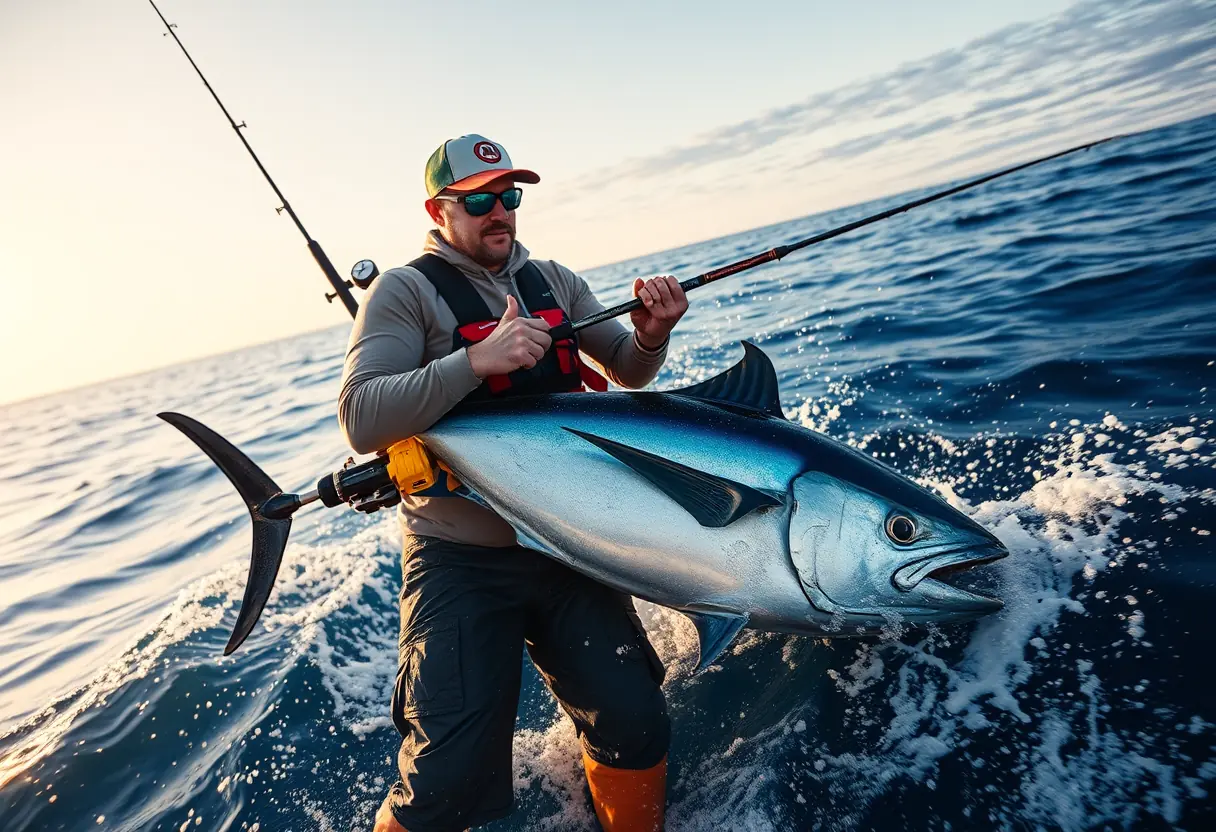
There’s no chair on this boat. There doesn’t need to be.
The bump-and-wind is the standup technique that gets a giant bluefin from two hundred feet down to the gaff without a fighting chair, without a harness bolted to the deck, and without four hours of dead time. It’s a rhythm: bump the rod tip up, wind down fast, repeat. And it works because it turns a static tug-of-war into short, repeatable gains that a fish can’t out-strategize forever.
The Rig
Run a two-speed lever drag reel, the Penn International VI or the Shimano Tiagra, spooled with 80-130lb monofilament or a braid-to-mono topshot, matched to a 50-80lb class standup rod with roller guides. Roller guides matter here: under sustained heavy drag, a standard guide train generates enough friction heat to weaken line at the wraps. Roller guides don’t.
Leader is 15-20 feet of 200-300lb fluorocarbon, connected via a Bimini twist to a doubled main line and crimped or hand-tied to a circle hook sized to the bait. Circle hooks are non-negotiable on bluewater tuna: they set themselves in the corner of the jaw on the fish’s own run, which means fewer gut-hooked releases and a cleaner boat-side fight.
The Technique
- Strike. Drag is set at 30-35% of line strength. The fish takes the bait, the circle hook finds the corner of the jaw on the fish’s own momentum. You don’t set the hook; the rig does.
- The first run. Let it go. A green bluefin’s first run can strip 300+ yards in under a minute. Fighting it here burns your arms for no gain. Thumb the spool lightly for heat management only, don’t clamp down.
- Bump-and-wind. Once the run stops, this is the whole fight: lift the rod tip 12-18 inches, wind down fast as you drop the tip back, lift again. Every cycle gains a few feet of line. It’s monotonous. It’s supposed to be: a fighting chair does the same thing with a mechanical pump, you’re doing it with your legs and the harness.
- Gear up. Once the fish is within 100 feet and you can feel it tiring (shorter runs, less headshake), shift the two-speed reel to high gear and increase drag toward strike-plus-30%. This is where the fight actually ends. Most anglers who lose a bluefin boatside lost it here by staying in low gear too long.
- Boatside. Leader man takes the doubled line or leader by hand once it’s within rod-length. Gaff placement is behind the head, ahead of the pectoral fin, in one motion. A half-committed gaff shot on a green fish is how gear gets destroyed and hands get hurt.
What Kills This Rig
Drag creep. Lever drags shift under sustained load if the lever isn’t locked hard against the stop. Check it before every fish, not just at the dock.
Standing too close to the gunwale during the first run. A giant bluefin’s first run has enough force to pull an unbraced angler into the rail. Set your stance before the strike, not after.
Undersized leader for the fish you’re actually marking. If the sonar is showing 150-pound-plus arches, 200lb fluoro is the floor. A school-size fish on lighter leader fails differently than a 400-pound fish doing the same thing: the leader doesn’t break on the first run, it fails boatside when the fish surges on a tight drag and the line contacts the hull or a cleat. Build the leader to the fish you expect to see, not the fish you’d prefer.
Reel heat on a long fight. A 45-minute battle with a giant bluefin will cook drag grease in a reel that hasn’t been serviced since the previous season. If drag pressure softens mid-fight with no change to the lever, heat is the cause. Service the drag washers before the season starts, not after a fish exposes the problem.
The Canyon Run guide covers the SST tactics and trolling spread that puts fish in range of this rig. No drag left on the reel when this setup is dialed right.


